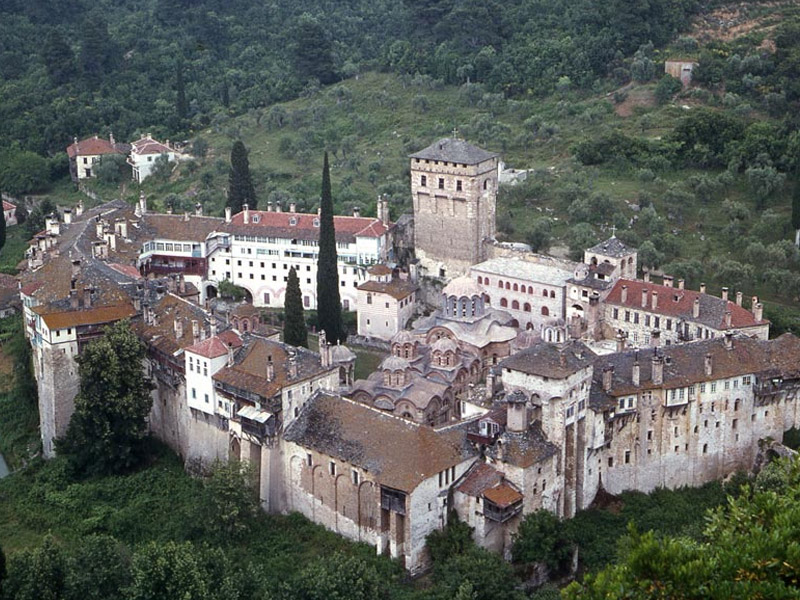
The Holy Mount Athos is an autonomous and self-governed territory of Greece. It occupies the whole of the third peninsula of Halkidiki, about 50 km in length and having a breadth of 8-12 km covering an area of 330 square kilometers. In the centre of the peninsula of Mount Athos rise a long range of hills and mountains, culminating in Mount Athos itself, 2,033m above sea level.
The boarder of this monastic state, where it meets the rest of Greece, is marked by an imaginary line drawn from Francocastro on the western coast across to Cape Arapis on the opposite coast, passing close it the foothills of the mountain “Megali Vigla” (Megas Zigos).
Until the 3rd Century BC, many small Greek towns existed on the peninsula of Athos, principally colonies originating from Chalkida and Eretria. The most important of which were Sani, Ouranoupolis, Thisson, Kleones, Dion, Akrathos and Olofixos.
Later, these towns declined or were destroyed.
Dionisiou monastery was built in the middle 14th century by the monk Dionysious of Koryssos in the Kastoria precinct, with
Lear More Monastery Dionisiou
Esfigmenou monastery is built by the sea and surrounded by a rectangular wall which forms a rathwer spacious courtyard. In
Lear More Monastery Esfigmenou
Grigoriou monastery is built by the sea, in the S.W. side of the peninsula, between the monasteries of Dionysiou and
Lear More Monastery Grigoriou
The history of Hilandar monastery begins in the 10th century but, after its ruin, the emperor Alexius III, in 1198
Lear More Monastery Hilandar
Third in precedence among the twenty monasteries of the Holy Mountain, Iveron monastery was built in the end of the
Lear More Monastery Iveron
Stavronikita is one of the smallest monasteries of Mount Athos following however the traditional architecture, with the Katholicon in the
Lear More Monastery Stavronikita
Xenophontos monastery it is built by the sea, between the monasteries of Docheiariou and St Panteleimonos, and is dedicated to
Lear More Monastery Xenophontos